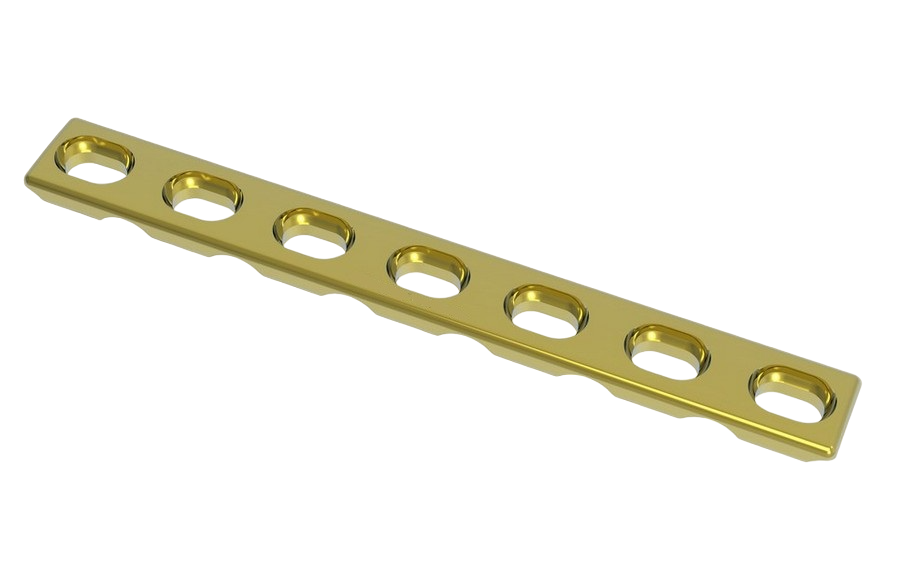
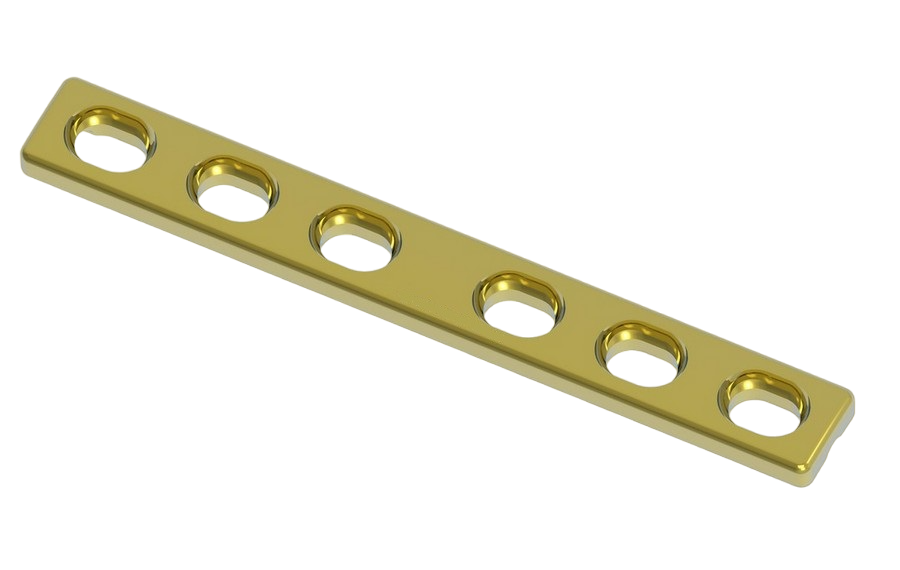
The Locking Compression Plate (LCP) is part of a stainless steel and titanium plate and screw system that merges locking screw technology with conventional plating techniques. The Locking Compression Plate System has many similarities to existing plate fixation methods, but with a few important improvements. Locking screws provide the ability to create a fixed-angle construct while
utilizing familiar AO plating techniques. A fixed-angle construct provides advantages in osteopenic bone or multifragmentary fractures where traditional screw purchase is compromised. Locking screws do not rely on plate/bone compression to maintain stability, but function similarly to multiple small angled blade plates.
Small Fragment Locking Compression Plates (LCP) are intended for fixation of fractures, osteotomies and nonunions of the clavicle, scapula, olecranon, humerus, radius, ulna, pelvis, distal tibia, and fibula, particularly in osteopenic bone.
The following points distinguish treatment using locking screw technology from conventional plating techniques:
• It enables fracture treatment using compression plating with conventional cortex or cancellous bone screws.
• An LCP plate can also be used as an internal fixator and permits stable bridging over shattered zones.
• The LCP system permits the combination of conventional and locking screws.
• Cortical locking screw permits better vascularity